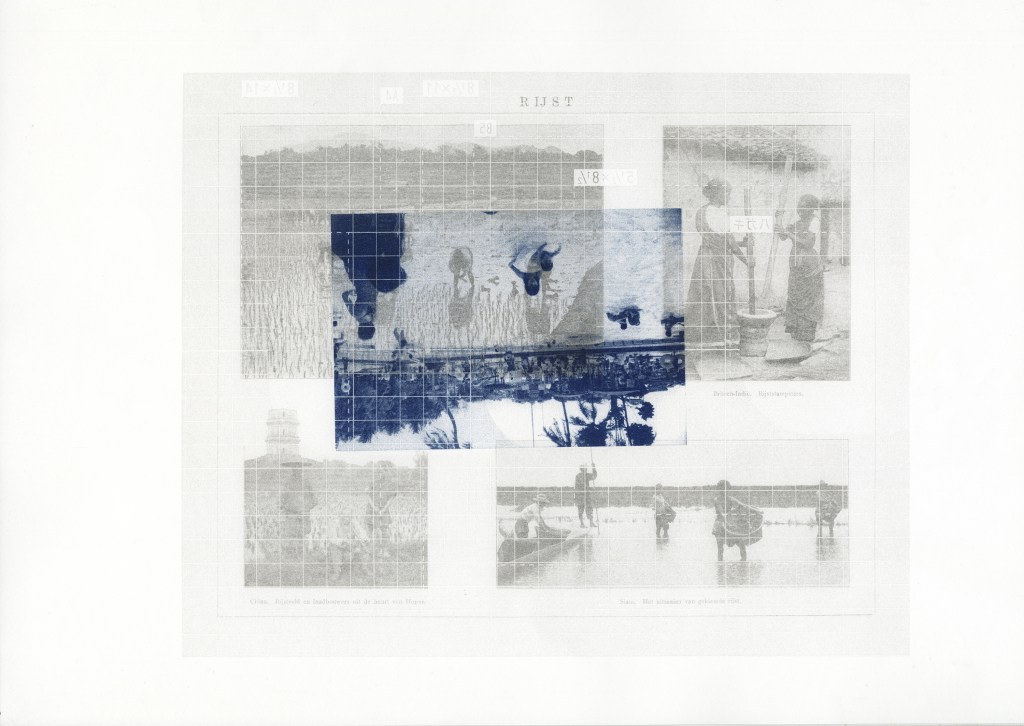
The sun greeted me, but not for long. It’s probably the last bit of summer. I arrived in the Netherlands after an eighteen-hour flight from Indonesia in September 2023. According to the institution calendar, I’ll have the time and space to focus on my practice and have my own studio. For the next two years, my studio resides in a state monument, the “Kavallerie Kazerne”, a former cavalry barracks built in 1864 that could accommodate two hundred horses and men. The dominating palette is gray and the hallway looks like the passageway of a ship.
The wind was too strong; I felt cold. I held onto the mittens my best friend gifted me at the departure gate. I slowly put them on my hands; warm, warm. But it was September, and they told me it was too early to wear mittens, so I put them in my pocket and went to see their world.
at the photo fair
Sumatra Medan Java
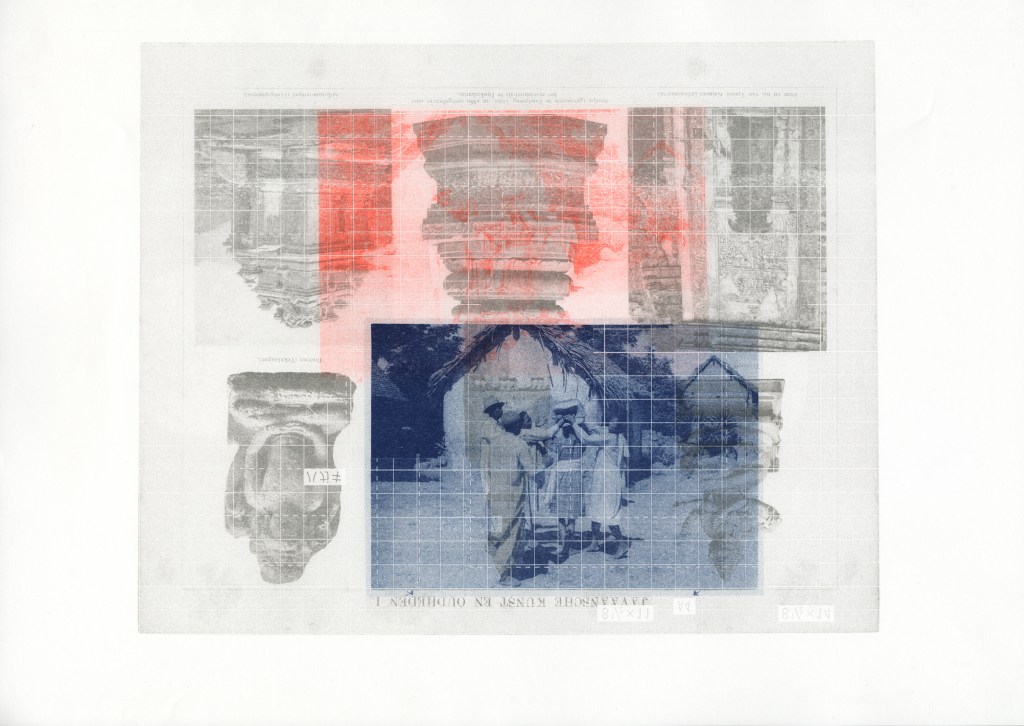
The back of each photo is labeled with a region of a place I call home. They are put into thick plastic and displayed like collectibles. The photographer is unknown; all that remains is a location. Some photographs are landscapes, a few are staged portraits, with the “subject” either looking away or staring tensely into the lens, as if they didn’t have a choice but to obey a stranger’s wishes. But their names, oh…they seem to have been forbidden in those times.
I overhear a lady beside me saying:
I’m looking for Indonesia
She is not referring to a physical place, but an image that no longer exists. A tropical paradise in a distant colonial memory. As Roland Barthes says of temps écrasé: “In the photograph we are looking at something that has been and is no longer there.”
(picture 1)
Two palm trees overlooking the sky with two bamboo houses Siestastemming in de dessa
Siesre au village
A place to rest
You can have this Sumatra for € 250
(picture 2)
Palm tree in the background
Three people swimming at the pool, two ladies on a floatie a big towel hanging on a fence
Gentleman with a white suit and round hat
Navigating the lack of the sun in Europe, I understand why these images might feel necessary. The four corners of an image become something that can be felt, not only looked at: a place to nap in the heat of the day. However, they still believe that I come from a place of beauty, without scars and vulnerability; they call it mooi indie.
(A row of carton boxes with labels on each of them)
Swimming Dancing Cooking Children
If you were here with me, you might flip through the photos and stop at one that piques your attention. You would carefully hold its edges and avoid placing it into a box with a different label. “Portrait of a couple dancing at the ball” cannot go side by side with “photograph of a villager in rural Africa carrying a basket above her head.” How obsessed one can become with the idea of collecting, naming, and labeling.
(picture 3)
A mother swims behind her daughter Pushing her on a floatie
In my home, a diptych of two photographs that I brought from Jakarta. A photo of my grandmother’s orchid in her old house and an image of my mother holding me on a yellow floatie, wearing a black swimsuit, smiling. A moment after my departure, she kept calling me, reciting the last text I sent her before boarding my flight. There were palm trees in the background, but no one was wearing a white suit, only a group of families spending time with their kids, a moment of togetherness. It hung on the walls of my bedroom, the only two printed photographs I brought from home, no label, no plastic wrap. I honored the stranger in the pool who obeyed my mom’s wish to take our portrait. I no longer recognized my mom in the picture of her early motherhood.
***
at the storage hall
3401-1565
3401-841
3210-77
273-54
526-271
A big storage hall filled with rows of open shelves, and on each of the shelves, identical numbered labels disguising thousands of different objects from Western Papua, a former colony of the Dutch East Indies that is still fighting for its independence under an oppressive Indonesian military today. Household items such as
wooden comb, textile bag, mirror,
palm leaf box, wooden spoon,
were put in the same hallway. While jamasj or defence weapons from Asmat were displayed along with rocks, spear, and human remains inside a box, untouched. As you walk past them, your eyes try to scan every color and texture in awe and sadness. The row of barcodes, like items in a supermarket, are there to remind you that these objects were looted not because of their valuable ancestral knowledge but merely as part of the continuous extraction of a former colony.
You can take pictures but please do not touch
I could not help but imagine how these thousands of objects were transported back then.
Decades after the Dutch left Indonesia, they kept these collections inside a storage facility with temperatures ranging from 17 to 20 degrees Celsius, away from the public eye. Seeing Papua through the museum storage is seeing the gathering of knowledge for a view of the land, seeing the curation of a land. Objects without touch is how I see a community without tradition; or humans without memory. Imagine losing your memory one day, waking up without knowing where and who you are. These objects have lost their touch, separated from the possibilities of nameless creatures, invisible movements, and formless shapes that roam the infinite expanse that is “there”.
Recently, the West started a new progressive attempt at returning colonial objects back to their origins. They have names for it: repatriation and rematriation. They have a name for everything.
Almost 1,000,000 photographs and 450,000 objects are in the collection
We have things from all over the world, except Europe
Indonesia: 114,616
We try to break the barrier for the public to access our collection
[no image available]
Violence or human remains might be involved
Violence won’t be visible in the archive. It can only be felt when it happens in real time.
Before leaving the storage, delicate green and gold feathers called to me. The eyes were half-closed, like it was trying to rest. I gasped. It was Cendrawasih, the bird of paradise. There were two of them, inside a box, wrapped in plastic. When the museum opened, they put up posters across Amsterdam:
Leert Tropisch Nederland Kennen Bezokt het Koloniaal Museum Amsterdam
Get to know the tropical Netherlands Visit the Colonial Museum Amsterdam
Whose deaths are not being shown?
Fransisca Angela is a multi-disciplinary artist from Indonesia. Her work mainly touches upon human stories in relation to place, the in-between, and collective memory.
 GULLY MAGAZINE